
From Spontaneous Decision to Finish Line: My First 10K Journey and Training Insights
Picture this: five uninterrupted hours of free internet access on an airplane. For some, it might mean catching up on emails or binge-watching a new show. For me, it led to a rather exciting and entirely spontaneous decision: I signed up for my first-ever 10K race! This unexpected turn of events proves just how dangerous – and exhilarating – a little free time and internet access can be.
The Spontaneous Decision: 10K vs. Half Marathon
My fingers hovered over the registration button for the Philadelphia Half Marathon, scheduled for the end of November. The thought of tackling 13.1 miles seemed incredibly appealing, a true test of endurance and a significant milestone. However, a quick reality check reminded me that my current average run hovers around the four-mile mark. Jumping to a half marathon within a few months, with minimal prior distance training, felt a bit too impulsive. A commitment of that magnitude – both physically and time-wise – truly warrants more than a couple of hours of deliberation.
That’s where the 10K, a manageable 6.2 miles, came into play. It felt like the perfect balance between challenging myself and being realistic about my current fitness level and time constraints. Not only is it a significant step up from my usual runs, but as it’s my first 10K, I’m guaranteed a personal record (PR), which is a nice little confidence booster right off the bat!
For many new runners or those looking to increase their distance, the 10K offers an ideal stepping stone. It requires dedicated training but is less demanding than a half or full marathon, making it an accessible goal that provides a real sense of accomplishment. It also allows you to focus on form, pacing, and building endurance without the overwhelming pressure of extreme distances.
Conquering Rolling Terrain: A Look at the Rhinebeck 10K Course
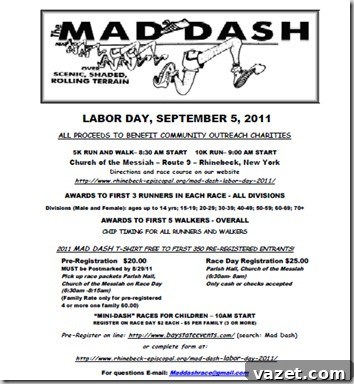
The race organizers describe the course for the Rhinebeck 10K as featuring “scenic, shaded and rolling terrain.” If you’ve spent any time looking at race descriptions or real estate listings, you quickly learn to read between the lines. “Rolling terrain” in the running world is often akin to “cozy” in real estate advertising. It’s a polite way of saying “hilly.” While the term evokes a gentle, pleasant image, seasoned runners know it means embracing inclines and declines throughout the race.
Understanding the course profile is crucial for race preparation. Hilly courses require a different strategy than flat ones, demanding more varied muscle engagement and careful pacing. You can’t just power through; you need to conserve energy on the climbs and leverage the descents. Looking at the elevation map provided a clearer picture:
As anticipated, the map confirmed a series of challenging ascents and descents. This means my training will need to incorporate more than just flat pavement runs. Hill repeats and incorporating varied inclines into my weekly mileage will be essential to prepare my legs and lungs for race day. It certainly adds an extra layer of challenge and excitement to this first 10K experience!
Crafting a Realistic 10K Training Plan
With exactly one month remaining until the Rhinebeck 10K, and given my recent running history hasn’t seen much beyond five miles, putting together a solid training plan became my immediate priority. A structured approach is key to building endurance safely and effectively, especially when aiming for a specific distance.
My upcoming four weeks present a few logistical hurdles. I have a 12-hour car trip to the beach, a bachelorette party weekend, and a work trip spanning at least three days. These events certainly complicate consistent training, but I believe I’ve structured a plan that can adapt. Flexibility is crucial when life throws curveballs, and sometimes that means adjusting the timing of runs or opting for shorter, higher-intensity sessions when long ones aren’t feasible.
Based on past experience, I find that three days of running per week works best for me. This schedule offers several advantages:
- It helps prevent burnout, allowing for adequate recovery between running sessions.
- It creates space in my week to consistently incorporate strength training, which is vital for injury prevention and overall running performance.
One specific aspect of my plan that might need tweaking is scheduling strength training sessions, particularly from programs like New Rules of Lifting for Women (NROLFW), on days immediately preceding my long runs. I’ve noticed that the delayed onset muscle soreness (DOMS) from these workouts can sometimes last up to two days, which could negatively impact the quality and enjoyment of a longer run. Ideally, strength training should be spaced out to allow muscles to recover fully before demanding endurance efforts.
For anyone devising a 10K training plan, especially with a busy schedule, consider these tips:
- Prioritize Long Runs: Even if you have to shift them, ensure your longest run of the week happens. This builds critical endurance.
- Incorporate Variety: Don’t just run at the same pace. Include tempo runs, interval training, and hill work to build speed and strength.
- Listen to Your Body: Rest days are just as important as running days. Don’t push through pain that could lead to injury.
- Strength Train: Focus on core, glutes, and leg strength to improve running economy and prevent injuries.
- Cross-Train: Activities like swimming, cycling, or yoga can enhance cardiovascular fitness and aid recovery without the impact of running.
Setting Smart Race Goals: More Than Just a Time
When it comes to setting a goal for this specific race, I’m exercising a degree of caution. As my inaugural 10K on a notoriously hilly course, a definitive time goal feels somewhat elusive and potentially restrictive. Furthermore, upon cross-referencing with Google Maps, the course appears to be approximately 0.2 miles longer than the advertised 6.2 miles. This seemingly small discrepancy can significantly impact time predictions and personal expectations, as I learned during a previous half marathon.
Race predictors, when fed data from my most recent longer race (the HOHA 5-miler), suggest I could potentially complete a 10K in 51 minutes and 16 seconds, which translates to an 8:14 per mile pace. While an exciting prospect, this feels quite ambitious for my first attempt on a challenging course. Therefore, I’m setting a more realistic and attainable goal: finishing under 55 minutes, aiming for an 8:51 per mile pace.
My strategy for race goals has always leaned towards setting achievable targets. There’s a powerful psychological boost that comes from not just meeting but exceeding your own expectations. It fosters a sense of accomplishment and fuels motivation for future challenges. Conversely, setting an overly ambitious goal that you don’t meet can be discouraging, even if you’ve performed well overall. This approach allows me to focus on the race experience, the course, and my effort, rather than solely on an arbitrary time that might be out of reach given the variables.
On race day, my plan will be to start conservatively, especially with the “rolling terrain.” I’ll focus on maintaining a steady effort on the uphills and allowing gravity to assist on the downhills, while keeping an eye on my overall pace. The primary goal is to enjoy the experience of my first 10K and finish strong, knowing I’ve prepared diligently.
Beyond the Finish Line: Future Race Ambitions
Once the Rhinebeck 10K is behind me, I’ll revisit the idea of the Philadelphia Half Marathon. On one hand, completing a 10K means I’ll have already covered nearly half the training mileage required for a half marathon, making the transition feel more natural. Plus, I absolutely adore running in the crisp, vibrant air of autumn, making the late November timing ideal. The thought of training through the beautiful fall season is incredibly appealing.
On the other hand, I honestly don’t miss the significant time commitment that half marathon training demands. It’s a different beast, requiring longer runs and a more rigid schedule that can sometimes feel all-consuming. The decision will ultimately come down to my energy levels post-10K, my desire for another intense training block, and how well I manage to integrate training into my busy life. The 10K will serve as an excellent barometer, informing my readiness and enthusiasm for a longer distance.
Embarking on this 10K journey, from a spontaneous plane decision to a focused training plan, is an exciting chapter in my running life. It’s a testament to the idea that sometimes the best adventures begin with an unexpected click of a button.
Share Your Running Journey:
- What upcoming races are you currently training for, or have you recently completed?
- Have you ever raced the Philadelphia Half Marathon or any other major city races? What was your experience like?
- How do you approach setting your personal race goals, especially for a new distance or challenging course?