
How not to make macarons: An honest outline of three different methods for making macarons and their often-humbling results. This journey explores common pitfalls, crucial lessons, and the unwavering spirit of an amateur baker determined to master the notoriously tricky French macaron.
The Allure of the Macaron: A Culinary Obsession Begins
My first true encounter with a macaron was a revelation, approximately two years ago, nestled in the vibrant atmosphere of Le Panier in Seattle’s iconic Pike Place Market. Up until that point, these delicate, colorful confections had somehow evaded my palate. It was a time when my foray into food blogging was just beginning, and ironically, as I savored my latte and this newfound pastry on the lone open stool in the bustling bakery, I observed two other enthusiasts. They were meticulously photographing their individual macarons with an intensity only possible with professional-grade cameras and hefty lenses.
Then, armed with my trusty five-year-old point-and-shoot, I struggled to comprehend the devotion required to spend a full fifteen minutes capturing the perfect shot of a baked good, rather than simply enjoying it. The word “blog” drifting from their conversation, however, soon connected the dots. Fast forward two years, and I can confidently say I’d fit right in at that very table, though my approach would include ordering a few extra macarons to ensure one could be promptly devoured before any photography commenced. Priorities, after all, have a way of evolving.
Since that initial encounter, macarons have become an unavoidable presence in the world of food blogs, a sphere I admittedly follow with perhaps a little too much zeal. The thought of attempting to bake these delicate treats myself had slowly blossomed into a “must-do” on my culinary bucket list, especially when your life, as mine often does, revolves around food. So, when Lindsay announced this month’s kitchen challenge focusing on macarons, I interpreted it as a definitive sign. This was my moment to embark on the macaron mission.
My Macaron-Making Journey Begins: A Tale of Three Attempts
Setting the Stage: Amateur Baker, Big Dreams
It’s important to preface this by stating upfront: I am not, by any stretch of the imagination, a seasoned baker. My kitchen currently lacks several fundamental tools that many macaron recipes deem essential. For instance, I do not own a kitchen scale, and stubbornly resisted the idea of purchasing one solely for the precise measurements demanded by macaron ingredients. Furthermore, my “pastry bag and tips” setup consists of a simple ziplock bag with a corner unceremoniously snipped off. These details, as you might infer, offer a glimpse into the challenging road ahead for my macaron-making endeavors.
Attempt #1: The False Start and the Wax Paper Woes
For my inaugural macaron attempt, I meticulously followed an online recipe from a highly trusted source. Stella, renowned for her precise and reliable baking expertise, seemed like the perfect guide for these fickle confections. I even watched several video tutorials by Mardi, based on Stella’s recipe, no fewer than three times before even thinking about cracking an egg. I’ll admit, a surprising wave of confidence washed over me, believing I might just conquer these notoriously tricky treats.
The Meringue Misadventure: A Test of Patience
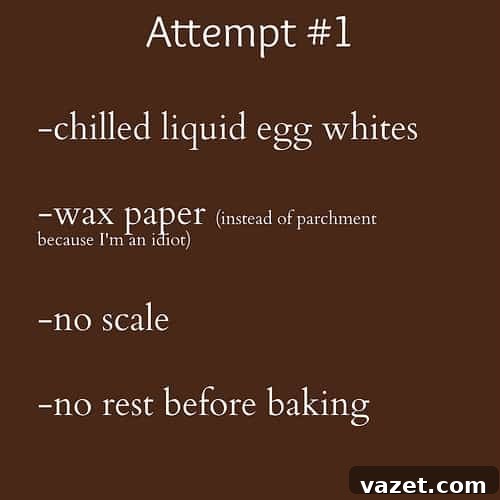
That fleeting confidence evaporated around the six-minute mark of beating the egg whites. Mardi had confidently stated that chilled liquid egg whites worked perfectly fine in her rendition of the recipe. Being budget-conscious and unwilling to waste the remaining yolks from half a dozen organic eggs (because honestly, what does one do with that many yolks if a custard isn’t on the day’s agenda?), I opted for this route straight away. However, by minute six, as my mixer churned away, the egg whites showed barely any signs of foaming. A sinking feeling told me I was already in deep trouble.
By minute twelve, with the mixture still looking like little more than bubbly liquid, I had resigned myself to utter failure. I planned to head upstairs, change into “store-appropriate” clothing, and make a quick run for more powdered sugar, food dye, and fresh eggs for Batch #2. Yet, I happened to leave the mixer running. To my astonishment, when I returned downstairs around the twenty-two minute mark, the egg whites had miraculously transformed, appearing somewhat fluffy and whipped! Abandoning my plans, I tossed my bag onto a chair, cranked my KitchenAid mixer to full speed (level 10), and whipped them vigorously for another two minutes. At this point, it felt like a 50/50 gamble, and I decided to just roll with it.
From Oven to Disaster: Flat Shells and Sticky Situations
The subsequent step, carefully folding in the dry ingredients, proceeded far more smoothly than I had anticipated. As I carefully placed the piped macaron shells into the oven, using wax paper instead of the intended parchment paper by a regrettable oversight, a spark of hope ignited within me. I literally sat in front of the oven door, an absolute idiot, praying and talking to those little suckers, begging them to puff up and develop their characteristic “feet.”
Eighteen agonizing minutes later, this was my reality:
They possessed tiny, almost imperceptible feet, but were otherwise almost as flat as pancakes. Upon biting into them, there was barely any of that delightful chewy middle beneath the fragile, eggshell-like exterior. And then, there was the infamous wax paper incident. For those wondering, no, wax paper is decidedly not non-stick.
A midday twelve-mile bike ride was absolutely necessary to clear my head and reset. After that, it was back to the store to restock and reattempt this culinary challenge.
Attempt #2: Renewed Hope, Persistent Puzzles
For Batch #2, I felt a surge of renewed optimism. This time, things were looking significantly more promising right from the start. When my egg whites achieved this perfect, glossy peak after about ten minutes of diligent whipping, I thought to myself, “Yes, this is it. This is the batch that will yield perfect macarons.” The meringue was voluminous, shiny, and held its shape beautifully – a stark contrast to my first attempt.
I carefully piped the batter onto a proper parchment-lined baking sheet, envisioning those characteristic “feet” appearing as they baked. I was genuinely confident that I had finally conquered the delicate art of macaron making. I was certain this batch would emerge from the oven as elegant, perfectly formed French macarons.
Except, that didn’t happen.
The Elusive Feet: A Question of Puffage
While I achieved respectable “puffage” – a decent rise and dome – there was not even a discernible toe, let alone the coveted macaron feet. The shells were smooth and round, but lacked that signature ruffled base. The absence of feet was a significant letdown, especially after the perceived success of the meringue. It seemed there was more to master than just the egg whites.
Despite their aesthetic shortcomings, these tasted remarkably good. The internal and external textures were much improved, closer to what a macaron should be. Interestingly, the baking surface didn’t seem to be the issue this time; using a Silpat mat versus parchment paper yielded similar results in terms of the elusive feet. This further deepened the mystery of what exactly I was doing wrong.
However, with a small amount of batter still remaining in my makeshift piping bag, I decided to soldier on to Attempt #3, determined to uncover the secret.
Attempt #3: The Resting Theory and Ultimate Frustration
After exhaustively googling phrases like “why won’t my macarons grow feet,” a common piece of advice emerged: many bakers swear by letting the piped macaron batter rest and dry out before it goes into the oven. This “resting” period, they claimed, allows a skin to form on the shells, which in turn helps create the characteristic feet. This was despite Stella’s recipe indicating that a resting period wasn’t strictly necessary. While the precise baking terminology and scientific explanations behind it remained largely beyond my comprehension, I figured it was worth a shot as a last-ditch effort.
So, I sat impatiently, occupying myself by uploading my various macaron failures to Instagram, for what felt like an eternity but was actually about an hour, waiting for my piped shells to “dry.”
And then, the moment of truth arrived. The result?
This batch was arguably the worst of the day. The shells were completely hollow underneath, lacked any chew factor whatsoever, and, predictably, had no feet. They more closely resembled amputees from the waist down than delicate French pastries. The resting period, in my case, had seemingly exacerbated the problems rather than solved them.
At this point, I conceded defeat for the day. I showered and prepared for a birthday dinner, where I promptly drowned my frustrations in a bacon Manhattan and a pound of king crab legs, attempting to erase the memory of these bastard pastries and the utterly frustrating day they had caused.
Common Macaron Challenges and What I Learned
My three attempts, though largely unsuccessful in producing perfect macarons, offered a wealth of learning opportunities. It became clear that macaron baking is a delicate balance of precision, technique, and understanding the science behind each step.
The Importance of a Kitchen Scale
My stubborn refusal to buy a kitchen scale was, in hindsight, a significant handicap. Baking, especially with finicky recipes like macarons, demands precise measurements. Volume measurements (cups and spoons) can vary wildly, whereas weighing ingredients ensures consistency. Without a scale, achieving the correct ratio of almond flour, powdered sugar, and egg whites is a shot in the dark, directly impacting the macaronage and final texture.
Temperature Control: Oven Thermometer is Key
Another tool I realized I desperately needed was an oven thermometer. Oven temperatures can fluctuate dramatically and rarely match what the dial indicates. Incorrect oven temperature is a leading cause of macaron failure, from cracking to hollow shells or the complete absence of feet. A consistent, accurate temperature is crucial for proper rise and structure.
Mastering Meringue: Egg Whites Matter
My first attempt’s struggle with egg whites highlighted their paramount importance. Achieving stiff, glossy peaks is fundamental. Whether using fresh or aged, liquid or carton egg whites, their temperature and how they are whipped directly influence the meringue’s stability and ability to hold air. Over-whipped or under-whipped meringue spells disaster for macaron shells.
The Art of Macaronage: Folding to Perfection
Macaronage, the process of folding the dry ingredients into the meringue, is often cited as the most critical step. My varying results, even with seemingly good meringue, suggested I had not yet mastered this. The batter needs to be folded just enough to achieve a lava-like consistency, flowing off the spatula in a ribbon. Over-mixing leads to runny batter and flat, footless shells, while under-mixing results in lumpy, cracked macarons.
Drying/Resting Time: To Rest or Not to Rest?
My third attempt explored the resting period, a controversial topic among macaron bakers. While some swear by it to form a protective skin, my experience was negative. This might be due to other underlying issues, but it proves that what works for one recipe or baker might not work for another. It likely depends on humidity, recipe specifics, and personal technique.
Baking Surface: Parchment vs. Silpat
The wax paper incident was a glaring error, teaching me the absolute necessity of a non-stick, heat-resistant baking surface. Both parchment paper and Silpat mats are recommended. While my second attempt with Silpat still lacked feet, it was an improvement over the wax paper catastrophe, suggesting that once the fundamental issues are addressed, the choice of surface primarily affects the texture of the bottom of the shell.
My Unwavering Macaron Mission (and a Silver Lining!)
Despite these initial, frustrating setbacks, my determination to conquer these elusive pastries remains unwavering. I tend to get obsessive about challenges like this, and simply cannot end on a note of failure. I am pretty sure that true macaron success will undeniably require a significant investment in proper baking tools – specifically, a reliable kitchen scale and an accurate oven thermometer. These will be my next acquisitions, forming the foundation for future, more successful attempts.
If nothing else, my culinary adventures yielded a few silver linings. My dog, Ginger, thoroughly enjoyed a few extra “snack” remnants throughout the day, ensuring no ingredients truly went to waste. Furthermore, it provided an excellent excuse to play around with my new camera lens and tripod. While I’m absolutely smitten with the tripod, the jury is still out on the new lens. But one thing is for sure: the macaron journey is far from over.
Your Macaron Wisdom Wanted!
Do you have any invaluable macaron tips or secrets you’ve discovered in your own baking endeavors? Share your wisdom!